En route to the Côte d'Azur
Find the best routes to Marseille now
The trip to the Cote dAzur by train is straightforward, comfortable, and easy to plan. The route offers a steady shift from central Europe to the Mediterranean, and the journey itself becomes a practical part of the travel experience. The change in landscape is clear, the connections are simple, and the travel time stays predictable. Travelers can choose between night trains, daytime routes, or a mix of both, depending on where the journey begins.
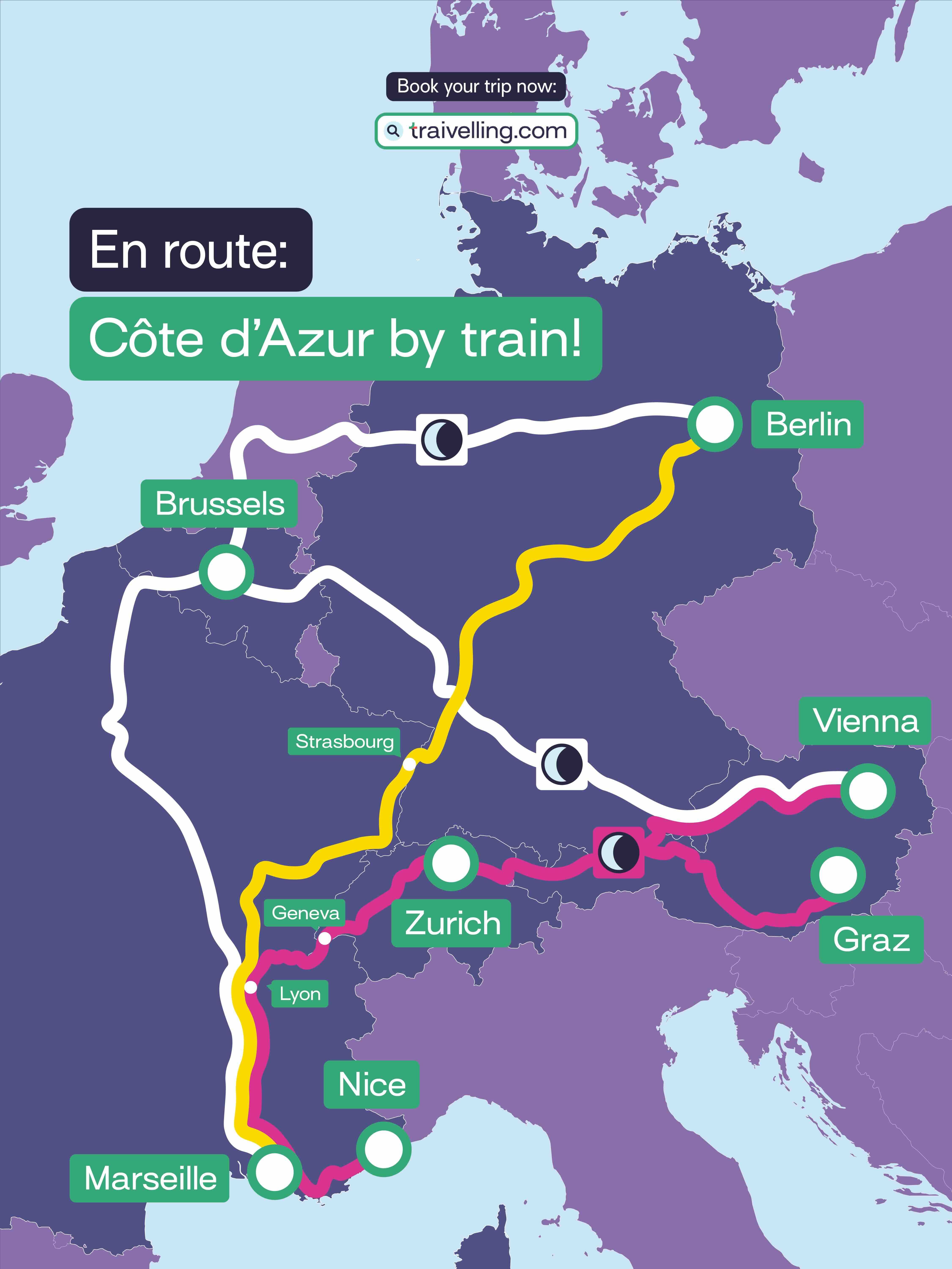
There are three main options when starting in Berlin, Vienna, or Graz. Each option has its own schedule and structure, and all are built around smooth transfers and reliable timing.
From Berlin/Vienna via Brussels
One option is the night train from Berlin or Vienna to Brussels. The Berlin train departs at 22:56 and reaches Brussels at 09:27. The Vienna train departs at 18:13 and arrives at 09:55. This connection runs three times per week. The overnight section makes it possible to cover most of the distance during sleep, which can be practical for travelers who want to save daytime hours for exploring or onward travel. After arriving in Brussels in the morning, the onward connection to Marseille takes 5 hours and 41 minutes. This daytime segment offers a clear view of the French landscape and leads directly toward the southern coast. It is a simple two-part route: a full night train followed by one daytime train.
From Vienna/Graz via Zurich
Another option is the night train from Vienna or Graz to Zurich. The Vienna departures are at 21:39 or 23:28, and the Graz departure is at 21:43. From 15 December onward, the route uses the new Koralm Tunnel, which improves the connection. The train arrives in Zurich the next morning at 10:20 or 11:29. From Zurich, the onward route goes south via Geneva and Lyon and then continues to Nice. This option creates a clear north to south progression: an overnight trip into Switzerland, then a daytime train through France. It is suitable for travelers who prefer a longer daytime segment or want to travel through several regions in one trip.
From Berlin to Marseille via Straßbourg
The third option is a daytime route from Berlin. This journey begins with a train to Strasbourg that takes 5 hours and 45 minutes. Strasbourg sits on the border between Germany and France and serves as an easy transfer point. The next train continues from Strasbourg to Marseille in 6 hours and 8 minutes. Both legs are simple daytime rides and allow travelers to follow the full route in daylight. This option can be useful for those who want to avoid night trains and prefer a clear, uninterrupted travel day.
All three routes share certain advantages. Train travel also allows more flexibility with luggage and removes the need for security lines or early check-in procedures. For travelers that value lower-impact travel, train routes support sustainable movement across Europe.
The progression toward the Cote dAzur is clear on all routes. The architecture, vegetation, and light shift gradually, which creates a natural sense of arrival. Reaching the region by train makes the transition from departure point to destination straightforward without sudden changes in environment. The train arrives directly in the city center, which simplifies the next steps, whether the plan is to go to the beach, walk through the old town, or continue to nearby towns along the coast.